

State to state car shipping gets stressful when a cheap quote turns vague, pickup dates blur, and nobody explains what happens when the truck cannot fit on your street. You need the real process, not “easy transport” promises.
What matters is the route, the vehicle, the pickup window, and who is responsible once it rolls away. We’ve seen the small details decide whether a move feels smooth or exhausting.
- Why a nearby meeting point can be normal
- What a low quote may leave out
- How to inspect the car before handoff
Move your vehicle with fewer surprises.
What State-to-State Car Shipping Really Means
State to state car shipping is exactly what it sounds like: moving a vehicle across state lines instead of driving it yourself. Once a move crosses state borders, it becomes an interstate shipment, which follows a federally regulated process and uses licensed transport carriers.
That matters more than people think. A local move from one city to another in the same state is not handled the same way as interstate car shipping. The routes, carrier availability, paperwork flow, and scheduling patterns can be different.
This kind of shipping covers a lot of ground, literally:
- a short hop from Georgia to Florida
- a multi-state relocation from Ohio to Texas
- a full coast-to-coast move from California to New York
When people search terms like ship car to another state, out of state car transport, or car transport between states, they’re usually looking for the same thing: a clear way to get the vehicle moved without turning the trip into a second full-time job.
In most cases, the shipment is arranged as door-to-door service. That means the carrier picks up and delivers as close to your addresses as a commercial truck can safely reach. Not always your exact driveway. Usually pretty close.
It’s also one of the most common transport jobs in the industry. That helps. Popular interstate routes tend to have better truck availability and more competitive pricing than people expect. The route still matters, but you’re not asking for something unusual here.
Why Shipping a Car to Another State Often Makes More Sense Than Driving
A lot of people start by thinking, “Maybe I should just drive it.” Fair question. Sometimes that is the right move. But once you add up the real cost, the time, and the wear on the car, the answer changes fast.
This is where shipping stops feeling like a luxury and starts feeling practical.
If you’re relocating for work, helping a student get to school, heading south for part of the year, buying a car online, or trying to move two household vehicles at once, driving can become a mess. One person can only drive one car at a time. Families know this problem well.
Here’s where shipping usually wins:
- You’re flying to the new state and need the car to meet you there
- You’re moving with kids and don’t want a two-day highway slog
- You’re coordinating more than one vehicle
- You want to avoid putting long-distance mileage on the car
- Weather on the route looks bad, or it’s just the wrong season to be on the road
Fuel, hotel stops, food, missed work time, tire wear, and maintenance creep up quickly. People often count gas and forget everything else. That’s how a “cheaper” drive becomes an expensive one by the second afternoon.
For businesses, the logic is even simpler. If a company needs to move employee vehicles, dealer inventory, or work trucks between states, interstate car shipping keeps people working instead of sitting on the interstate for ten hours.
And no, nationwide auto transport is not only for luxury cars. We move ordinary sedans, family SUVs, and pickup trucks every day. Most shipments are not exotic. They’re just real people trying to solve a real logistics problem without burning a week to do it.
How Interstate Car Shipping Works From Quote to Delivery
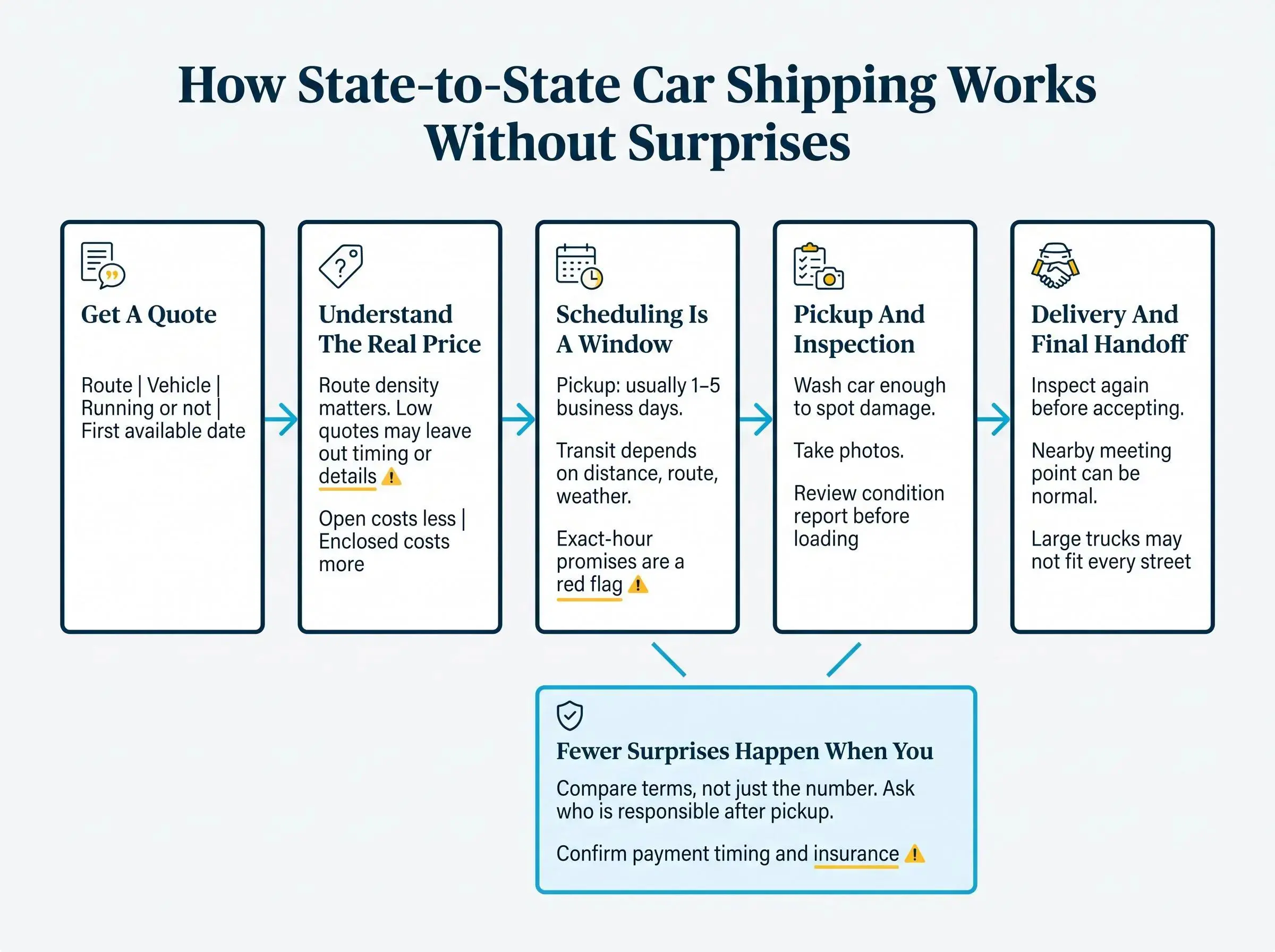
If you’ve never booked transport before, the process can feel vague from the outside. It’s actually pretty straightforward once you see the sequence.
Here’s the basic flow.
How the process typically works
- Get a quote
Request a quote You provide pickup and delivery locations, the vehicle type, whether it runs, and when you’d like it moved.
- Pick transport type
Choose open or enclosed transport Open costs less and works for most vehicles. Enclosed gives more protection and usually makes sense for higher-value or more delicate vehicles.
- Schedule shipment
Confirm scheduling Once the order is placed, the shipment is scheduled and matched with a carrier.
- Pickup inspection
Pickup and inspection When the driver arrives, the vehicle condition is reviewed and documented before loading.
- Delivery handoff
Delivery and final handoff At delivery, the vehicle is inspected again before you or your representative accepts it.
That inspection step matters. Don’t rush it because the truck just arrived and everyone wants to keep moving. A five-minute review can prevent a bigger argument later.
Broker vs carrier
This is one point people should understand before booking. A carrier is the company with the truck that physically hauls the vehicle. A broker coordinates the move, connects the shipment with a licensed carrier, and manages the process.
We operate as a transport broker, which means we help arrange the shipment rather than asking you to hunt down trucks on your own. For a lot of customers, that makes car transport between states much easier. You’re not trying to negotiate with drivers, sort out route fit, or piece together your own schedule.
Our nationwide open and enclosed auto transport service is built around that broker-managed model. It’s door-to-door, carrier insurance coverage is included, and we don’t require upfront payment until pickup. People notice that last part. They should.
What It Costs to Ship a Car to Another State
Let’s get to the part most people care about first: car shipping costs. There isn’t one flat rate for state to state car shipping because the market moves with the route, the timing, the vehicle, and how easy the job is to load and deliver.
For a standard sedan or SUV on open transport, these are common ballpark ranges:
- Under 500 miles: about $350 to $650
- 500 to 1,000 miles: about $550 to $900
- 1,000 to 1,500 miles: about $750 to $1,200
- 1,500 to 2,500 miles: about $950 to $1,450
- 2,500+ miles: about $1,100 to $1,700
Enclosed transport usually runs about 40 to 60 percent more than open shipping.
One thing that surprises people: shorter moves often cost more per mile than longer ones. That’s because the fixed work doesn’t disappear. The truck still has to be dispatched. The car still has to be loaded, inspected, secured, unloaded, and documented.
What moves the number up or down
Distance matters, but route density matters almost as much. A vehicle moving between busy interstate lanes often prices better than a car going to a rural town, even if the mileage looks similar.
Other price drivers include:
- non-running vehicles that need special loading
- oversized SUVs or trucks
- lifted vehicles or modifications
- rural pickup or delivery
- rush scheduling
- seasonal demand swings
Direction matters too. The same route can price differently in reverse depending on truck flow and demand. That part catches people off guard.
The cheapest quote on the page is not always the cheapest shipment in real life.
Low numbers get attention. Clear terms save money.
If the pricing is vague, if the pickup timing is fuzzy, or if fees start appearing later, the quote wasn’t really lower. It was just incomplete.
How Long State-to-State Car Shipping Takes
Timing causes more stress than price for some customers, mostly because pickup dates and transit time get mixed together. They are not the same thing.
Pickup commonly happens within 1 to 5 business days of your first available date. On busy lanes, it can move faster. On remote routes or during tight market windows, it can take longer.
Once the vehicle is on the truck, a rough guide looks like this:
- Short interstate moves: around 1 to 3 days
- Mid-range routes: around 3 to 6 days
- Long hauls and cross-country shipments: around 6 to 10 days, sometimes longer
The total timeline includes more than truck time. It includes assignment, route planning, pickup coordination, and delivery sequencing. That’s the full experience your calendar feels.
A shipment can sit perfectly on track and still not move like a package with barcode scans every two hours. Car hauling doesn’t work that way. Trucks are moving multiple vehicles, dealing with live traffic, weather, road restrictions, and delivery order.
Flexible dates usually help in two ways:
- better pricing
- more scheduling options
If someone promises an unrealistically exact delivery date far in advance, slow down and ask more questions. A trustworthy interstate car shipping company should explain the timing clearly, not pretend the road is predictable down to the hour.
Open vs Enclosed Transport: Which One Fits Your Vehicle
This choice gets overcomplicated. It usually shouldn’t.
Open transport is the standard option. It’s the most common setup in state to state car shipping, and it’s the sensible choice for most daily drivers, family vehicles, standard SUVs, and pickups. It costs less and has broader availability.
Enclosed transport is the premium option. Your vehicle rides inside a covered trailer, which gives it more protection from weather and road debris. That added protection costs more, and sometimes a lot more depending on the route.
A practical way to decide
Choose open transport if:
- the vehicle is a normal-use car or truck
- you care more about budget than maximum shielding
- the vehicle already lives a regular outdoor life
Choose enclosed transport if:
- the car is high-value
- it’s a classic, exotic, or collector vehicle
- the finish, condition, or sentimental value makes extra protection worth paying for
The mistake we see is choosing enclosed because the whole process feels nerve-racking, not because the vehicle truly needs it. Fear is expensive.
On the other hand, if you’d lose sleep over a rare vehicle riding on an open trailer, that answer is already telling you something. Match the transport type to the vehicle’s real value and your real tolerance, not to marketing language.
What Door-to-Door Service Actually Looks Like
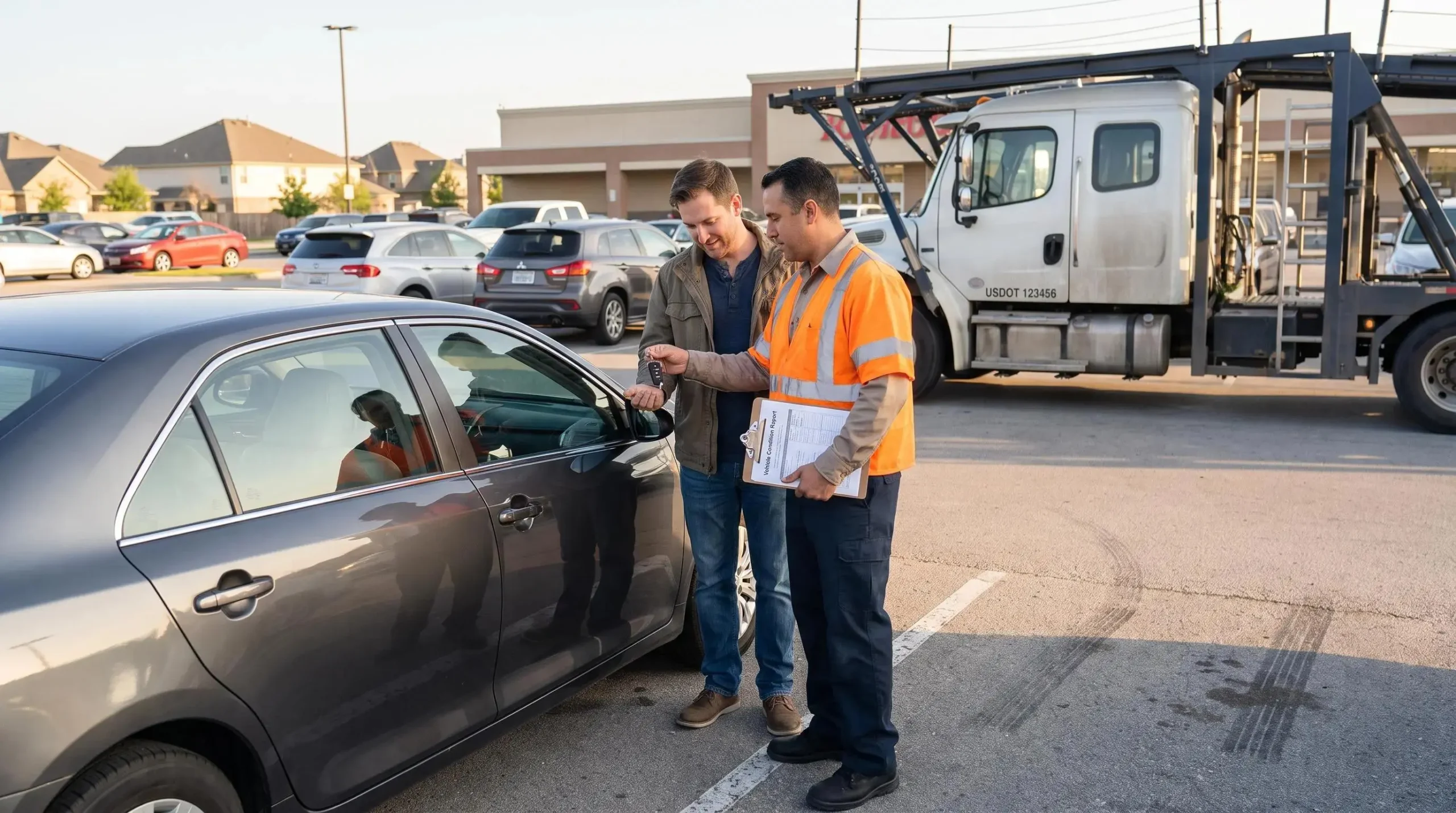
Door-to-door auto transport is convenient, but people should understand what the phrase means in practice. It usually means pickup and delivery at your chosen addresses, or as close to them as a large commercial truck can safely reach.
That last part is where reality steps in.
A full-size carrier may not be able to get directly in front of your house if there are narrow streets, tight turns, low branches, apartment access rules, HOA restrictions, or local limits on large trucks. In those cases, the driver may ask to meet at a nearby open area, wide street, or parking lot.
That’s normal. It’s not a bait-and-switch. It’s usually just the physics of a big truck in a small neighborhood.
Terminal shipping exists, but most households don’t want the extra handoff, extra coordination, or extra trip across town. Door-to-door tends to reduce hassle, which is why it’s the option most people ask for.
We arrange door-to-door shipping through our nationwide transport service, and carrier insurance coverage is included. The practical point is simple: convenience matters, but safe access matters more. A good delivery setup is the one that works without creating a new problem at the curb.
How to Choose a Company You Can Trust With Your Vehicle
For most customers, trust is the hard part. Not loading the car. Not signing the order. Trusting that the quote is real and the process isn’t going to get slippery once the vehicle is committed.
Start with legitimacy. The company arranging the shipment and the carrier hauling it should both be operating properly in interstate transport. You should also know who is doing what. Broker and carrier are different roles, and confusion there causes plenty of frustration.
Before you book, ask direct questions:
- What exactly is included in the quote?
- Is the price for open or enclosed transport?
- How are pickup timing and updates handled?
- What happens if dates or route details change?
- When is payment due?
If those answers come back muddy, that tells you something.
Red flags worth taking seriously
- pressure to book immediately
- vague “all-in” pricing with no detail
- weak or confusing insurance answers
- missing paperwork
- large payment demands before a truck is assigned
Payment structure is a real trust signal. We state that there is no upfront payment until pickup, and customers often tell us that changes the feel of the transaction. Fair enough. Paying big money before anything is scheduled makes a lot of people uneasy, and it should.
Transparent pricing matters for the same reason. Hidden fees are one of the fastest ways to turn out of state car transport into a bad memory.
How to Prepare Your Car for Transport Between States
Once the shipment is booked, your job is to make the handoff clean and documented. That alone reduces stress.
A simple prep checklist goes a long way:
- Wash the vehicle enough to make scratches or chips easier to spot
- Take date-stamped photos from multiple angles
- Remove personal belongings unless you’ve confirmed what is allowed
- Disclose whether the vehicle runs, and mention any modifications or loading issues
- Make sure the battery works if the car is operable
- Have the keys ready
- Confirm who will meet the driver if you can’t
If the car has oversized tires, low ground clearance, or mechanical issues, say so early. Drivers can work around a lot, but they can’t plan around surprises they weren’t told about.
At pickup and delivery, review the inspection report carefully. Don’t treat it like routine paperwork just because everyone is standing there with places to be. Those forms are one of your main protections.
The Most Common Mistakes That Make Car Shipping More Stressful
Most bad shipping experiences don’t start with disaster. They start with small assumptions that pile up.
Here are the usual trouble spots:
- Choosing the lowest quote without asking why it’s lower
- Booking late and expecting standard pricing with urgent timing
- Leaving out details about size, operability, or modifications
- Assuming door-to-door always means truck access right at the house
- Confusing the pickup window with the delivery window
- Skipping insurance and authority questions because they feel uncomfortable
- Treating the inspection like a formality
- Not reading payment terms closely on a short-notice move
The pattern is pretty consistent. When the customer lacks a clear mental picture of the process, every normal step feels suspicious. When the process is explained properly, most of that anxiety drops off.
Questions Readers Commonly Ask Before They Ship a Car to Another State
A few car shipping questions come up again and again, and they should.
Is state to state car shipping usually door-to-door?
Usually, yes. If the truck can’t safely reach the exact address, a nearby meeting point is common.
How far in advance should I book?
More lead time usually means better options and less pressure. Last-minute transport can still happen, but it often limits flexibility.
Can a non-running vehicle be shipped?
Yes, but it changes equipment needs and pricing because the carrier has to load it differently.
Does every car need enclosed transport?
No. Most vehicles move on open carriers. Enclosed is mainly for higher-value, collector, or more vulnerable vehicles.
Can someone else release or receive the vehicle for me?
Yes, in many cases, if that’s arranged ahead of time and the right person is there for inspection and handoff.
Why are some routes faster or cheaper than others with similar mileage?
Because mileage is only part of the job. Carrier traffic, route demand, season, and access conditions all affect scheduling and cost.
That’s really the bigger point. Interstate car shipping is manageable when you understand how the process works before you commit.
Conclusion
State to state car shipping doesn’t have to feel like a gamble. Most of the stress comes from not knowing how pricing works, what the timeline really means, or who is responsible once the car is booked.
Keep the decision simple. Choose the transport type that fits the vehicle, verify who is arranging the move and who is hauling it, understand what the quote actually includes, and prepare the car properly for pickup.
If you’re getting ready to ship car to another state, start by gathering the route details, vehicle information, and your preferred timing. Then compare quotes carefully and pay attention to the terms, not just the number. Clear beats cheap when your vehicle is involved.